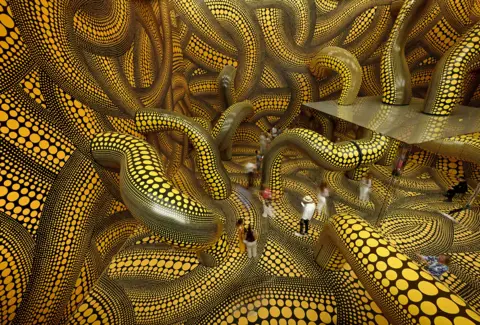
Known for her immersive infinity rooms, Yayoi Kusama uses mirrors and lights to create endless spaces that captivate and mesmerize viewers. Kusama passed this year at the age of 97. "She continued to paint until her final days, never setting aside her brush, and continued her exploration of forever love and eternal soul," stated her representative, David Zwirner.
Below is Kusama's Infinity Mirrored Room. Think: Mirror Maze on Steroids!
The Souls of Millions of Light Years Away 2013-Yayoi Kusama
My desire was to predict and measure the infinity of the unbound universe, from my own position in it. ~ Yayoi Kusama
Installation art makes me smile. The awe and thrill I feel in immersing myself in someone's art is transformative. Unlike traditional artworks confined to galleries or frames, installation art invites viewers to step inside and become part of the artwork itself. This form of art challenges perceptions, evokes emotions, and fosters a deeper connection between the observer and the space. We were fortunate to step into one of her installations this summer at the Louisiana Museum of Modern Art in Denmark. (I highly recommend it.)
Close-up of one of the many light dots
What is Installation Art?
Installation art involves arranging objects in a space to create an interactive experience. These artworks can be temporary or permanent and aim to engage the viewer's senses and emotions. Materials can range from natural items to digital technology, showcasing the artist's vision and the installation's context.
The Impact of Installation Art
Engaging the Senses: Installation art is a multisensory experience. It engages not only the eyes but also the ears, nose, and even touch. By activating multiple senses, installation art creates a more immersive experience, allowing viewers to feel connected to the artwork on a deeper level.
Challenging Perceptions: By altering familiar spaces, installation art challenges viewers to see the world from a new perspective. It can provoke thought, inspire dialogue, and encourage viewers to question their assumptions about art and the surrounding environment.
Creating Community Connections: Installation art often catalyzes community engagement. Public installations can transform urban spaces, bringing art into everyday life and making it accessible to a broader audience. These installations can spark conversations, foster community pride, and even inspire local cultural and social change.
Promoting Environmental Awareness: Many installation artists use their work to address environmental issues, using natural or recycled materials to create thought-provoking pieces. These installations can raise awareness about sustainability and encourage viewers to consider their relationship with the natural world.
See
Let's look at a few installations, starting with one more from Kusama. As you look at the images, try to imagine being immersed in the art installation.
Through the 1970s and early 80s, her work depicted an uncharacteristically dark series of collages in which she embraced the imagery of natural life cycles.
Valley Curtain project-Christo and Jeanne-Claude
On August 10, 1972, the artists, Christo and Jeanne-Claude, completed their large-scale environmental work, the Valley Curtain project, in Colorado. The project involved installing 18,600 square meters of woven nylon fabric across a mountain valley near Rifle.
This artistic duo was famous for their large-scale environmental installations, such as wrapping the Reichstag in Berlin. Christo (1935-2020) and Jeanne-Claude (1935-2009) formed a groundbreaking artistic partnership known for monumental, ephemeral environmental installations.
The Weather Project- Olafur Eliasson
Eliasson's works often explore the relationship between humans and nature, using light, water, and air to create stunning visual effects. For his 2003 installation “The Weather Project,” he put the sun and the sky in a hall of London’s Tate Modern gallery, complete with 200 lamps, mist machines and its own weather forecast service. People reacted to it in unprecedented ways: They started lying down to watch themselves in the mirrored ceiling, organized picnics, came in fancy dress – someone even brought a canoe.
Random International's "Rain Room" is an innovative installation artwork that combines art and technology. Visitors walk through a downpour but stay dry, thanks to sensors that stop the rain around them. This interactive piece highlights the symbiosis between art and viewer, emphasizing the role of technology in harmonizing with the environment. Originally designed for temporary exhibits, the first permanent “Rain Room” was installed at the Sharjah Art Foundation in the UAE in 2018. This artwork suggests a positive relationship with nature, moving away from exploitation for short-term gains. (the collector)
Random International aims to broaden the question of what it is to be alive today by experimenting with how we connect: to different kinds of life, to different views of the world, and to one another.
Say
Installation art is a transformative force in the art world, offering unique and engaging experiences that extend beyond traditional art forms. It fosters a deeper connection to the world around us by inviting viewers to become part of the art. Whether in a gallery, a public park, or an unexpected urban setting, installation art continues to inspire, challenge, and connect people worldwide.
How do you think installation art influences the way we perceive and interact with public spaces, and what impact does this have on community engagement?
In what ways can installation art serve as a medium for addressing and raising awareness about environmental and social issues?
Which Installation would you like to experience? How might you react?
Do
Next time you encounter an installation, take a moment to immerse yourself in the experience. Reflect on how it makes you feel and what it inspires within you.
Share your thoughts and experiences with others, and consider how installation art can transform spaces in your own community.
Kusama has a rich and troubling life that led to her lifelong drive to create art. Learn more:
Guided by her unique vision and unparalleled creativity, critically acclaimed artist Yayoi Kusama has been breaking new ground for more than six decades. In 1993, she became the first woman to have a solo presentation at the Venice Biennale’s Japanese Pavilion, and in 2016, Time magazine named her one of the world’s most influential people.
Born in 1929, Kusama grew up near her family’s plant nursery in Matsumoto, Japan. At nineteen, following World War II, she went to Kyoto to study the traditional Japanese style of painting known as Nihonga. During this time, she began experimenting with abstraction, but it was not until she arrived in the United States, in 1957, that her career took off. Living in New York from 1958 to 1973, Kusama moved in avant-garde circles with such figures as Andy Warhol and Allan Kaprow while honing her signature dot and net motifs, developing soft sculpture, creating installation-based works, and staging Happenings (performance-based events).
She first used the mirror as a multi-reflective device in Infinity Mirror Room—Phalli’s Field, 1965, transforming the intense repetition that marked some of her earlier works into an immersive experience. Kusama returned to Japan in 1973 but has continued to develop her mirrored installations, and over the years, she has attained cult status, not only as an artist, but as a novelist. Yayoi Kusama passed away on August 14, 2026.
I would love to share the Weekly Wonder with the world, making art and wonder more accessible to everyone!
Loving the Weekly Wonder?
If the Weekly Wonder has sparked your curiosity or added value to your week, please buy me a coffee to say thanks or consider upgrading to a paid subscription today. Your support directly funds the time and research it takes to build every single issue. If upgrading your subscription is not feasible, spreading the word means a lot!
With wonder and gratitude,
Please share your reflections with me by replying to this post, or post and tag my Wonder Wander Facebook or Instagram pages!
Self Portrait with a Teacup on the Head, 1987 I've looked this painting up many times, and I can't get it out of my mind. I'd love to learn more about it, but I can't find anything. It isn't a dynamic picture, yet there's something strange and calm about it that keeps pulling me back. See Why might a painting stay with you? If you are like me, you look at a lot of art. A gallery, a mural on your walk, a scroll through your phone. Some of it is beautiful. Some of it is technically impressive....
Rain Hopscotch by Peregrin Church Seattle artist Peregrine Church uses rain as his medium. By stenciling images and words on the sidewalk in water-repellent spray, he creates Rainworks—art pieces that appear only when it’s wet outside. Me. haha Unknown artist. 'Windy Weather' I have to say I am a sunny-day girl. I feel energy and an overall sense of contentedness when the sun shines. When it is overcast and rainy, I feel logey and chilly. Today is one of those days in the Twin Cities....
Watermark by Laura Haddad and Tom Drugan, 2010 Aluminum, 14 feet tall and spaced 125 feet apart “The water actually flows through the sculptures and pours out of their mouths so that the artwork is completely transformed into this functioning fountain-like structure while it's raining," Kati Ballares, the Director of Public Art for Scottsdale Arts, said. See Look closely at the giant faceted aluminum horse sculptures; each strikes a slightly different pose. They're lined up on stepped,...