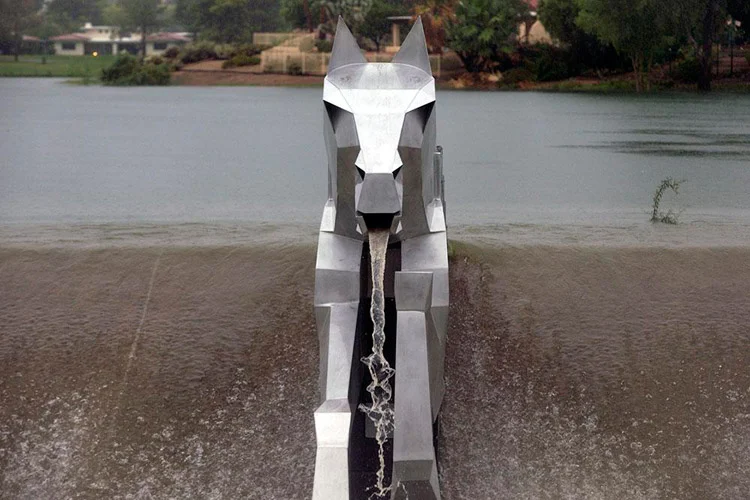
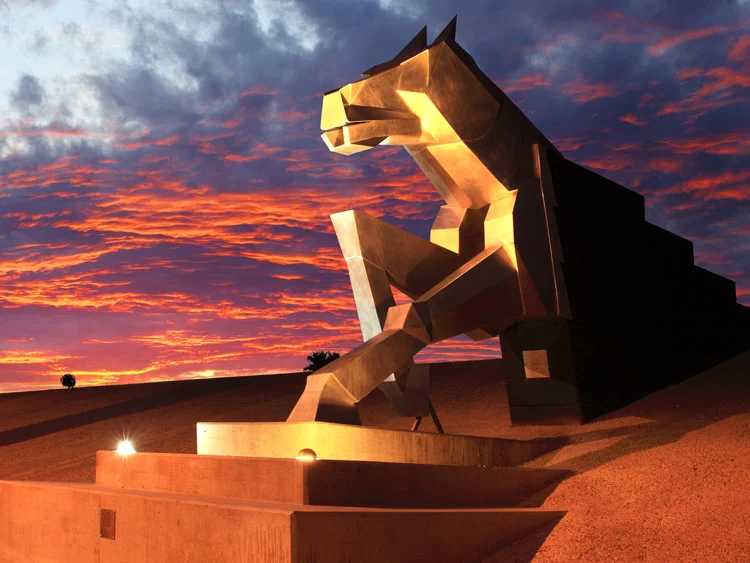
“The water actually flows through the sculptures and pours out of their mouths so that the artwork is completely transformed into this functioning fountain-like structure while it's raining," Kati Ballares, the Director of Public Art for Scottsdale Arts, said.
See
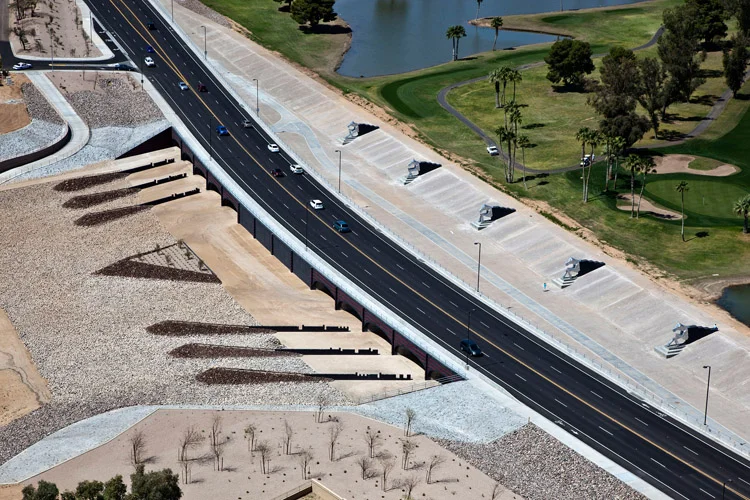
Look closely at the giant faceted aluminum horse sculptures; each strikes a slightly different pose. They're lined up on stepped, charcoal gray concrete bases, facing the traffic like sentinels. Some have their ears pricked back, as if they're listening for something far away. They are. They're listening for water.
Meet Water Mark, a sculpture in Scottsdale, Arizona, that spends most days dry, watching the sky, and then comes alive when the desert floods. During flash floods, these horses get to work. The artists say water "flows around and through them" in floods, not only from their mouths. The horses function as water spouts, like the gargoyles projecting from roofs of Gothic architecture.
Dredit Dan Kitwood/Getty Images
Although Scottsdale is known for rugged Sonoran desert terrain and saguaro cacti, it also experiences dramatic floods. As the city was developing, floods regularly occurred along the Indian Bend Wash, which runs through central Scottsdale. On June 22, 1972, the Indian Bend Wash backed up behind the Arizona Canal (shown below at Bonita and 74th Street), causing Scottsdale's most disastrous flood. Scottsdale Historical Society
unknown photographer Salt River Stories
The solution to Scottsdale's flooding problem is one of the city’s best-known stories. The Army Corps of Engineers originally pictured a huge concrete channel. Instead, Scottsdale ended up with the Indian Bend Wash Greenbelt: a ribbon of parks, lakes, paths, and golf courses that doubles as a flood-control system. On most days it’s a place to walk, bike, and play. On the rare day the water rises, it does the quiet work it was designed for.
Water Mark sits at the crown of that system. It makes an invisible job visible when, during floods, water pours from their mouths.
“Water mark” can mean a few things:
A high-water mark, the line a flood leaves behind to show how high it rose.
A watermark in paper, a faint image you see only when you hold it up to the light.
A mark made by water on the land, like a canyon or a streambed.
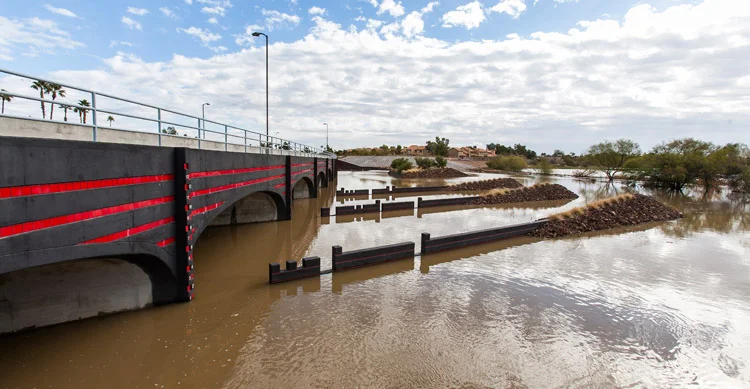
The artists use the first meaning literally. The stadia walls on the south side have square notches, protrusions, and one-foot red tile lines. As the water rises, it measures the changing water levels. The land keeps a record of its own weather.
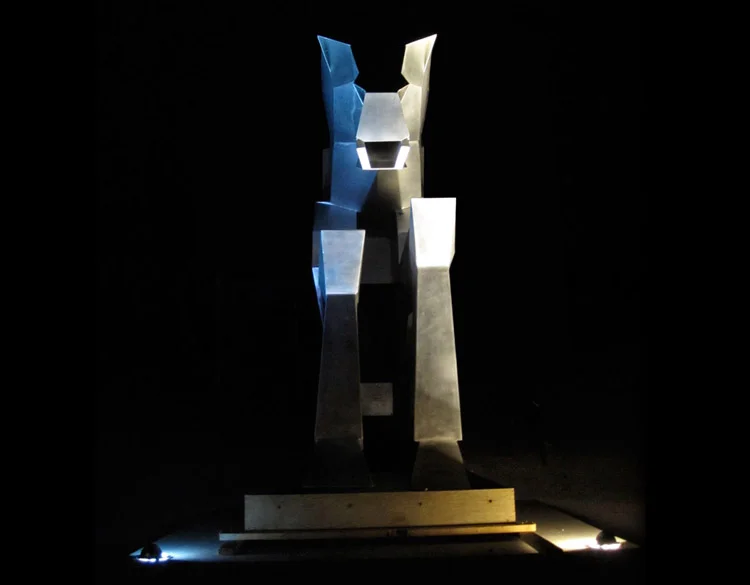
At night, they glow. Soft blue lights on the east side stand for water. Yellow lights on the west side stand for the sun.
Public art becomes part of the place it resides, and I believe it should reflect the history of the people and place where it stands. Here's a detail I love: the artists of Water Mark aren't from Arizona. Laura Haddad is an environmental artist based in Seattle, Washington, a city known for rain, not flash floods in the Sonoran Desert. So how does a team from the Pacific Northwest make something that feels so rooted in Scottsdale? By treating the place as the teacher. Haddad|Drugan didn't bring a ready-made sculpture and plop it into the wash. They started with what was already there: the way floodwater moves, the mesquite groves that turn into islands, the herons and egrets passing through, and the memory of the McCormick Arabian Ranch where the sculpture now stands.
I feel they really listened to and learned from the place, creating a sculptural infrastructure in Water Mark that fits perfectly where it stands.
Say
The fact that Haddad/Drugan are not from Scottsdale is a good reminder for any of us who feel like outsiders in a new place: you don't have to be from somewhere to care about it deeply. You just have to look, listen, and ask good questions.
What would it take for a stranger to understand the place you call home? What would you want them to notice first?
Most public art is "always on." Water Mark is "sometimes on." How does that change the way you feel about it?
Why might artists choose to honor a ranch that no longer exists? What do we owe to the history of a place?
Do
Create a 'gargoyle' for your own home. Gargoyles were invented to move water away from buildings. What creature would you put on your roof or garden wall to guard against the weather, or against worries? Draw it. Give it a name and a job.
Walk or bike the Indian Bend Wash path and visit the north basin to see the horses. After dark, notice the blue and yellow lights. wonderwander.art
Do you have a favorite piece of public art that only "comes alive" at a certain time, like a seasonal light show, a fountain, or a mural that changes in the afternoon sun? Hit reply and tell me. I'd love to feature it.
Loving the Weekly Wonder?
If the Weekly Wonder has sparked your curiosity or added value to your week, please buy me a coffee to say thanks or consider upgrading to a paid subscription today. Your support directly funds the time and research it takes to build every single issue. If upgrading your subscription is not feasible, spreading the word means a lot!
About the Artists: Laura Haddad and Tom Drugan
Haddad and Drugan have been creating public art together for more than two decades. They first met in graduate school in the 1980s, but didn’t formally join forces until 2002, when their inaugural project turned a car into a planter along Santa Monica Boulevard in Los Angeles. From there, the partnership flourished and became known as Haddad|Drugan, eventually amassing nearly 50 public art commissions. They have taught at the Rhode Island School of Design and the University of Washington and lectured in venues across the country. Their training in architecture and landscape architecture helps them to successfully translate art concepts to large scales, respond to contextual conditions, and integrate environmental processes into work that performs aesthetically, functionally, and ecologically. The artists’ award-winning work has been published in Sculpture, Architectural Record, Landscape Architecture, Eco-Structure, Landscape Journal, Land Forum, and other journals and books.
Water Mark received a Valley Forward Association Environmental Excellence Merit Award.
Madonna of the Rocks, 2024 Like the colored sand mandalas Tibetan Buddhist monks painstakingly craft and ritually dismantle once complete, Justin Bateman’s art is ephemeral. Using found pebbles as his medium, his stone mosaics only exist for the time of their creation. After photographing them, he destroys them by scattering the stones back to their original location or letting the weather break them down. See Look closely at a Bateman portrait, and you'll notice something: there is no paint,...
This week, we're exploring the world of Okuda San Miguel, a Spanish artist whose bold, multicolored murals have lit up walls on nearly every continent, and whose belief in art's power to bring people together extends far beyond the wall. His geometric, rainbow-bright art celebrates every one of us. You can see his murals on buildings and objects worldwide. How far and wide? India, Italy, Mali, France, the United States, Japan, Chile, Brazil, Peru, South Africa, Mexico, Canada, Morocco,...
Alice Mizrachi, Faces of Our Community, 2022 A first-generation migrant daughter, Alice Mizrachi grew up in Queens, New York. Her artwork, Faces of Our Community, is intended to unite the many cultures that make up her borough. To create this mural, the artist photographed residents and led collage-making workshops at Queens Community House. The resulting images are a mash-up of community members made by community members. A celebration of color and personality, the collages portray a diverse...