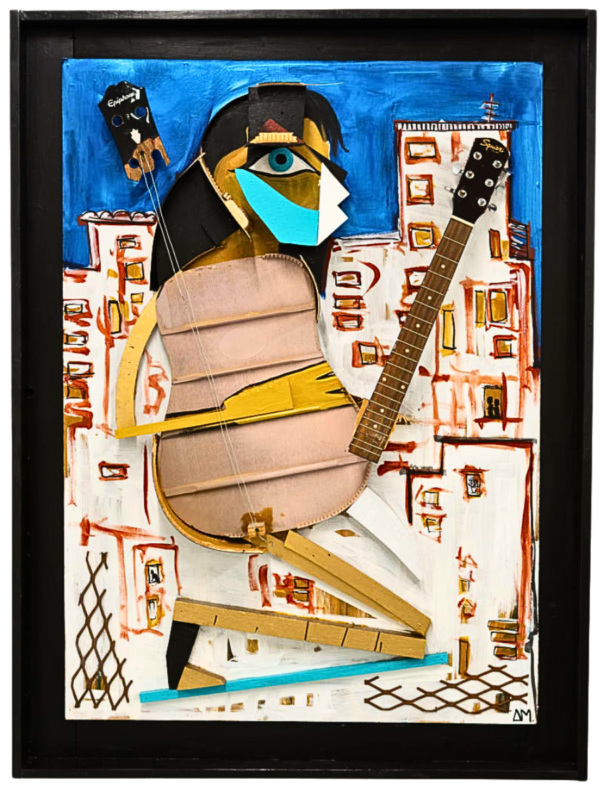
A first-generation migrant daughter, Alice Mizrachi grew up in Queens, New York. Her artwork, Faces of Our Community, is intended to unite the many cultures that make up her borough. To create this mural, the artist photographed residents and led collage-making workshops at Queens Community House. The resulting images are a mash-up of community members made by community members. A celebration of color and personality, the collages portray a diverse community's interconnectedness. (Artbridge)
See
The faces in this collaged mural are not celebrities. Not politicians. Not myths or symbols.
The grandmother who has lived in the same apartment for forty years. The teenager who sweeps up after school. The elder who nods at you every morning but whose name you never learned. They are so large that the neighborhood has no choice but to see them. She notes that the people love spending time looking at themselves and their neighbors. That's what the Public Art world calls 'Dwell Time' and, by some measures, a sign of success.
If you are noticing a reference to the work of Romare Bearden, you are spot on. As the New York Times reported in 2013, Alice taught art for ten years at St. Aloysius, a Harlem school. There, Russell Goings offered her access to his unseen collection of Romare Bearden's work in exchange for teaching her students about Bearden and Harlem's history.
The Divine Sound
She made it a vow: "I told him this is going to be one of my missions throughout my life, to preserve Bearden's history and the Harlem culture and make sure it lives in a rich and authentic way." Art, handed from one generation to the next. That's the wonder. The New York Times
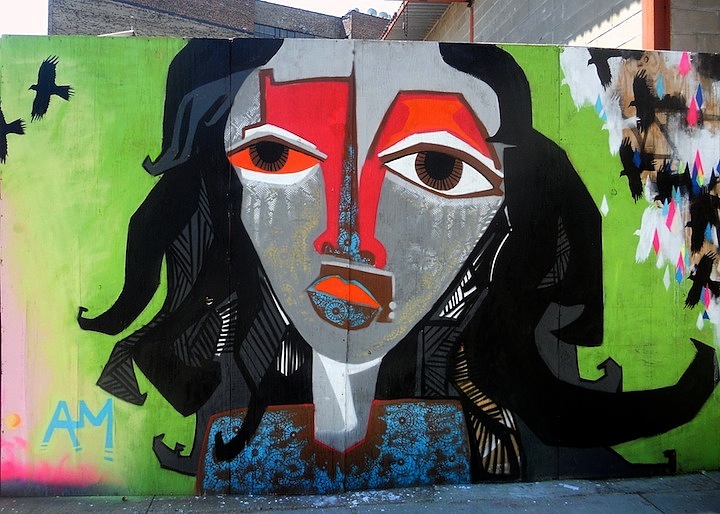
Collage is only one of her art forms. Her roots are deep in the New York street art and graffiti scene of the late 1980s and early '90s, where she learned to use walls as a canvas. But the work she's built over the years is something different from tagging or territory. It's testimony. It's portraiture as an act of love.
Stronger Together, 2020 Commissioned Mural, Brooklyn, New York, 5 Stories Tall
Before she lifts a brush, Alice talks to people. She walks neighborhoods, listens, asks questions. She shows up in schools, community centers, shelters, and correctional facilities places where people are often made to feel invisible. Her murals emerge from those conversations. They belong there.
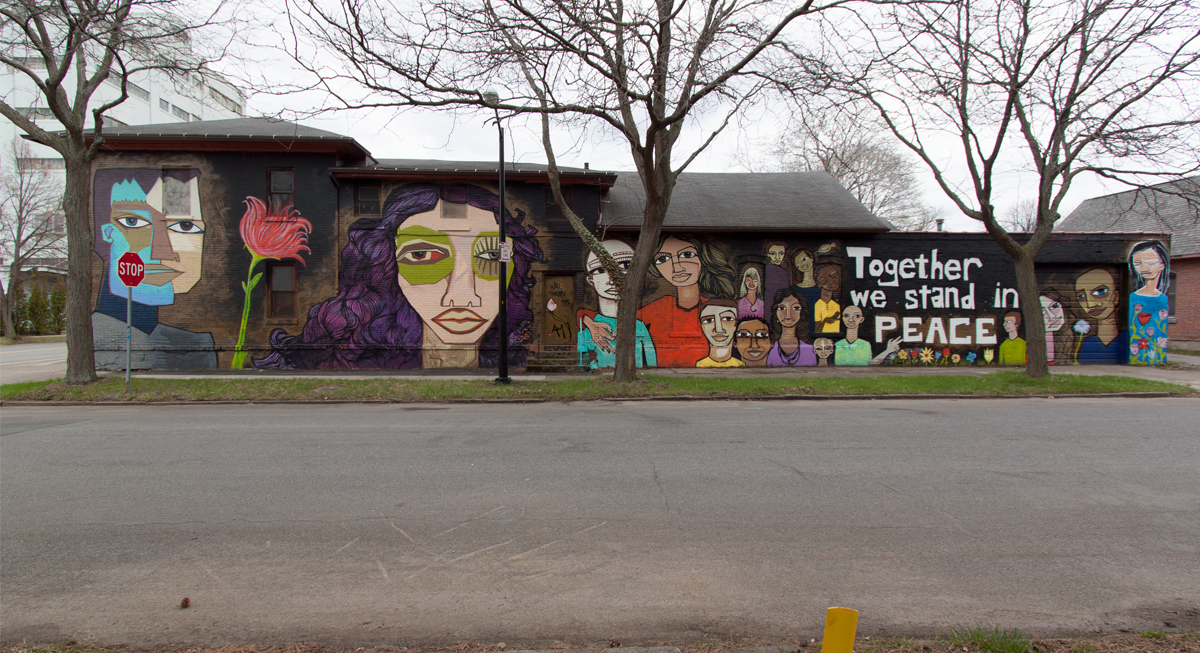
Alice Mizrachi, Together We Stand in Peace WALL\THERAPY 2014 (July 18, 2014 – July 27, 2014)
Viewers tend to linger longer on faces in artwork than on other subjects, and a lifted brow or the tilt of an eye can carry an entire story without a single word. (Think of Mona.)
That's not silliness. That's your brain doing its oldest job.
Tucked inside us is a region called the fusiform face area, which puts faces at the front of the line for our attention. Our earliest ancestors needed to spot a friend or a threat fast, so we are wired to notice the simple pattern of two eyes, a nose, and a mouth. Newborns, who can barely focus, will look longer at face-like shapes than at almost anything else. We arrive in the world already looking for each other. And our brains would rather invent a face than miss a social cue. That's why we see them in clouds, objects, and even abstract art.
When the face is someone you know...
Here's where the science gets interesting. If a stranger's face holds our attention, imagine what happens when it's familiar.
Alice paints versions of people from the communities where she works. So when a mural goes up, someone walking by may stop mid-step. Wait. I know her. Then comes the call to a friend: come look at this. And the words that turn a wall into a gathering place: That's my neighbor. That's my aunt. That's the man from the corner store.
Recognition is powerful. Our brains are built to light up for a known face, and a known face, forty feet tall, makes a whole block stop and look. People bring their friends and their kids. They take photos and tell stories. The mural stops being something that was put in the neighborhood and becomes something that belongs to it.
Made with the neighborhood, not just for it
These aren't idealized or beautified. They are specific, true, and full of dignity.
Notice how the scale changes everything. A face that fills the side of a building cannot be ignored the way a face on a canvas in a gallery can be. There's no velvet rope. No admission fee. You just turn a corner, and there they are. That's what I love about Public Art. It can influence anyone who sees it.
Let's Grow
Ask yourself as you look: Who is this person? What do I imagine their life to be? What does it feel like to live in a neighborhood and see yourself on the wall?
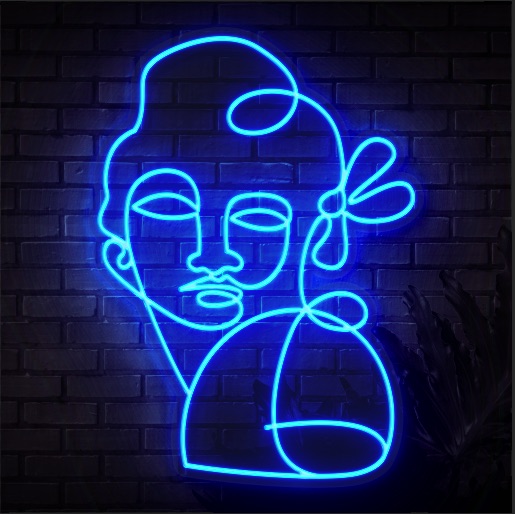
Single line Portraits
Law of Vibration
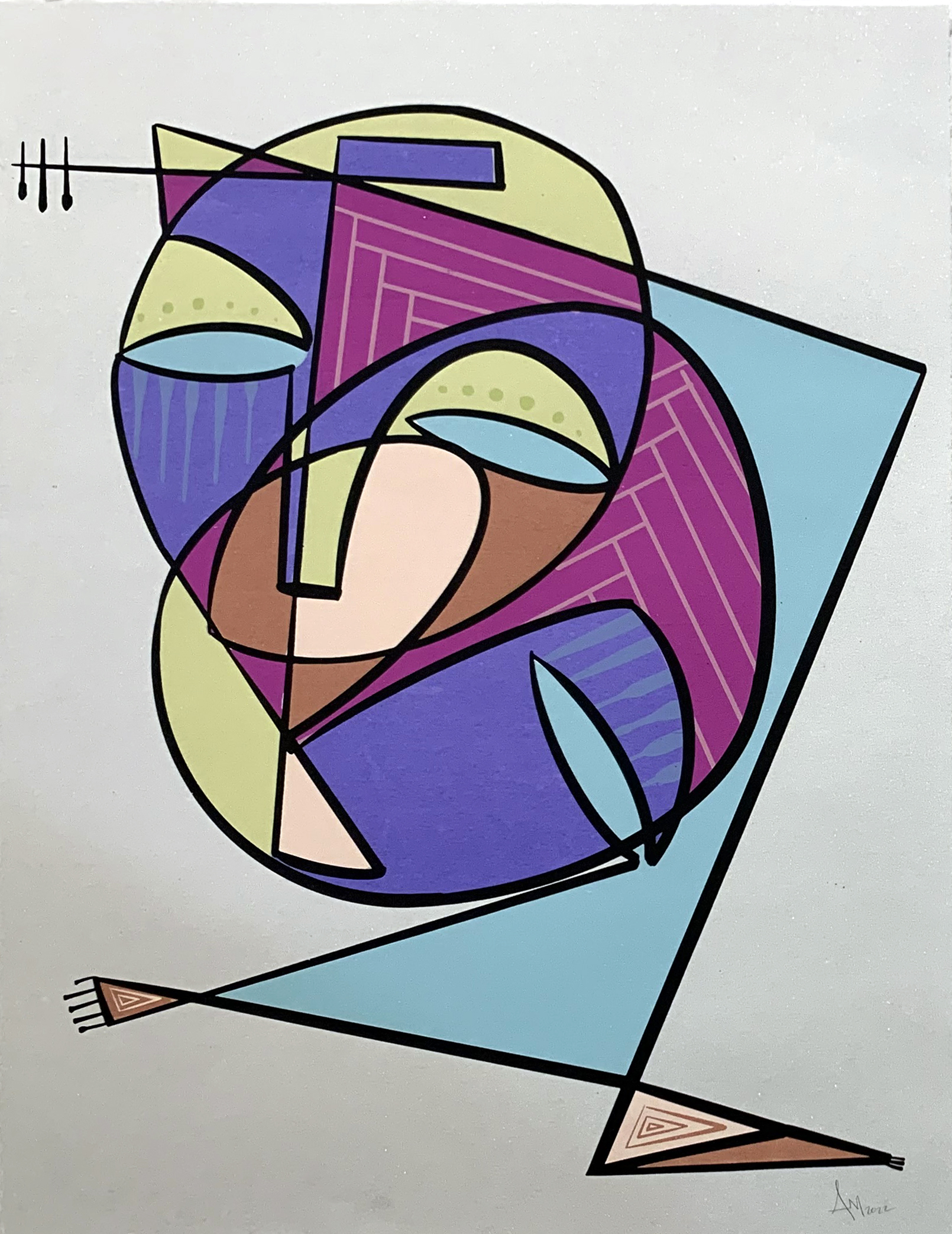
Alice described how her high school and college art teachers stressed the value of blind contour drawing as a way to really see the subject and improve drawing skills through hand-eye coordination. (openpalette podcast) She is perhaps best known for these beautifully expressive one-line portraits. I can't help but believe they stemmed from her history with contour drawing. Can you see this influence in some of the paintings above as well?
Neon Girl
Say
Alice Mizrachi reminds me of something I believe deeply from 30 years of teaching. Every student who walked through my door deserved to see themselves in the story we tell about the world. Children grow up knowing their face belongs in the story of this place. Public art can do that work at a city scale.
Is there someone in your life who shows up every day but is rarely truly seen? What would it mean to them (and to you) to really look?
It could be a neighbor, a coworker, someone who makes your coffee or delivers your mail, or even someone in your own household you've stopped noticing in the busyness of daily life.
Where in your world could a little more "being seen" make a difference?
Make a list of those you will take time to 'see' this week.
You do not need to be a trained artist. You do not need to get it right. This is about attention, not skill. Results are surprising yet somehow reflect the essense of the subject. Key: SLOW DOWN and look carefully.
Choose someone in your life — a family member, a friend, a neighbor you want to know better. Ask if you can spend five minutes really looking at their face. Then draw what you see. Don't draw what you think a face looks like. Draw this face. The particular way their eyebrows sit. The lines at the corners of their eyes. The shape of their mouth. (Blind contour is the best way to avoid drawing your assumptions)
When you're done, show it to them. Then notice what happens in the room.
If you want to take it further: write the person's name beneath the portrait and one thing you admire about them. Leave it somewhere they'll find it. On the refrigerator. Tucked in their bag. Propped on their desk.
That's it. Go see someone differently this week! Hit reply and share. I read every message.
Loving the Weekly Wonder?
If the Weekly Wonder has sparked your curiosity or added value to your week, please buy me a coffee to say thanks or consider upgrading to a paid subscription today. Your support directly funds the time and research it takes to build every single issue. If upgrading your subscription is not feasible, spreading the word means a lot!
About the Artist: Alice Mizrachi
Alice Mizrachi was born in Queens, New York, in 1977. She is a New York-based interdisciplinary artist and educator working in painting, murals, and installation. Her work explores the interconnectedness of individuals and community through the dual lens of compassion and empathy. Through figurative work that reinforces both personal and community-oriented identity, Alice aims to inspire creative expression and a sense of shared humanity through art.
Alice has worked as an arts educator for twenty-five years for a variety of organizations, including BRIC Arts, The Laundromat Project, and The Studio Museum in Harlem. As an advocate in socially engaged art, Alice has been recognized and selected to develop arts education curricula for organizations such as HI-ARTS (Harlem, NY), Dr. Richard La Izquierdo School, and Miami Light Project. She has also been a panelist discussing community-engaged art for events at Brown University and The Devos Institute of Arts Management.
As a painter, Alice maintains both a studio practice and an extensive body of work as a muralist. Her work has been featured in exhibitions at the Museum of the City of New York, the National Museum of Women in the Arts, the United Nations, and the Museum of Contemporary Art in Washington, DC. She has been commissioned as a mural artist for projects in Amsterdam, Berlin, Tel Aviv, and across the United States by organizations including: Wall Therapy (Rochester, NY); La Mama and Fourth Arts Block (NYC); Baldwin Civic Association (Baldwin, NY); and Chashama (Harlem, NY), among others.
Alice’s mural and installation work has been constructed in galleries and as part of site-specific arts education and community development projects. Her work often engages local communities and reflects positive visual responses to social issues affecting neighborhood residents. Her process activates a shared space of love, hope, optimism, and healing as a means to connect with participants. Frequent topics include the sacred feminine, identity, and migration.
Alice and her art have appeared in a variety of publications, including the book Outdoor Gallery: New York City, The New York Times, The Huffington Post, The Daily News, Time Out NY, and The Architectural Digest. She earned a BFA from Parsons School of Design and served as a guest instructor at the School of Visual Arts in 2015. Alice also co-founded Younity, an international women’s art collective active from 2006 to 2012. She has received grants from The Puffin Foundation and The Ford Foundation. Her recent projects include an artist-in-residence at Honeycomb Arts in Buenos Aires, curating a Latina art exhibit at Movimiento de Arte y Cultura Latino Americana, and a mural residency with The University of Northern Colorado.
Alice has worked with multiple organizations, including: BRIC Arts, The Laundromat Project, The Studio Museum, HI-ARTS, Miami Light Project, Brown University, and The Devos Institute. Her artwork has been featured at the Museum of the City of New York, the National Women’s Museum, and the Albright-Knox Museum, and in a variety of publications. Alice received a BFA from Parsons School of Design and grants from The Puffin Foundation and The Ford Foundation.
A Bird Named Goldilocks See Tucked inside a tree stump at a playground in Clove Lakes Park on Staten Island, New York, sits one of the most quietly magical public artworks you'll ever encounter (if you're paying attention). A Bird Named Goldilocks is a miniature bronze sculpture by Staten Island artist Anne Marie McDonnell, installed in 1995. At first glance, it looks like an ordinary stump. Look closer, and a tiny world reveals itself: a small bird has wandered into a scene straight out of a...
I Drivhuset (In the Greenhouse), Susanne Ussing, 1980 Susanne Ussing, I Drivhuset, Ordrupgaard Samlingen, 1980. Image Courtesy Carsten Hoff. The late Danish artist Susanne Ussing was fascinated by the female experience, a theme she explored extensively through a wide variety of media, from large-scale installations and interactive exhibitions to photography and ceramics. This stirring sculpture was created for the garden of the Ordrupgaard Museum in Copenhagen. It features a vast female...
Rust by Enzo Prina Acrylic on Panel 36 x 48 in., 2026 Enzo Prina is a young American artist (born 1997) based in Salt Lake City, Utah, who creates some of the most visually alive paintings you'll ever encounter. Working with acrylic on panel, miles of masking tape, and precisely layered lines, he builds paintings that do something almost impossible: they move. See His "Between Lines" series is exactly what it sounds like — art that lives in the in-between. Shimmering moiré patterns. Geometric...