Enzo Prina is a young American artist (born 1997) based in Salt Lake City, Utah, who creates some of the most visually alive paintings you'll ever encounter. Working with acrylic on panel, miles of masking tape, and precisely layered lines, he builds paintings that do something almost impossible: they move.
See
His "Between Lines" series is exactly what it sounds like — art that lives in the in-between. Shimmering moiré patterns. Geometric lines that ripple outward like sound waves. Color gradients that shift from warm to cool and back again, depending on where you're standing. Look straight on, and you see one thing. Step a little to the left, and the whole painting breathes differently.
Photon, 2025
This is called an optical illusion painting, which is rooted in a tradition called Op Art (short for Optical Art), a movement that boomed in the 1960s. Artists like Bridget Riley and Victor Vasarely made the world dizzy in the best way, creating paintings that tricked the eye into seeing movement, depth, and vibration on a completely flat surface.
Prina carries that tradition into today but with extraordinary technical patience. Every painting is built by hand. No computers, no digital printing. Just tape, paint, and an almost meditative commitment to precision.
RGBO, 2026
Loving the Weekly Wonder?
If the Weekly Wonder has sparked your curiosity or added value to your week, please buy me a coffee to say thanks or consider upgrading to a paid subscription today. Your support directly funds the time and research it takes to build every single issue! Thank you!
Untitled Pink and Blue, 2026
Get to know some OP artists!!
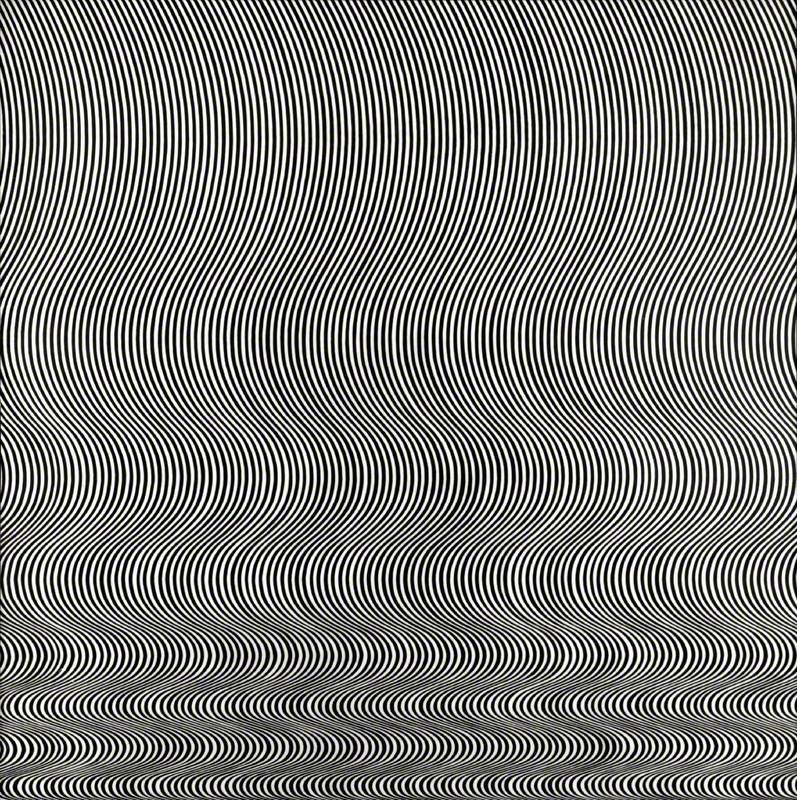
Fall, Bridget Riley, 1963
Fall offers the viewer a true optical illusion – the longer we look at the piece, the more distorted our vision becomes. Cascading illustrative lines ripple down the piece in a curving, swirling dance of black emulsion.
Cataract 3, 1967 and Portrait of Bridget Riley by Ida Carr
AGEV, Victor Vasarely, 1974
Hungarian-French artist Victor Vasarely (1908–1997) is considered a paternal figure in Op Art history. He began studying Medicine at university but abandoned it in 1927 to learn the techniques of traditional academic painting. In 1928, he enrolled in a private art school to concentrate on applied art and typographical design.
Portrait of Vasarely Hulton Archive /Getty Images and Vonal-Fegn, 1968-1971
Say
"Some things are better left between the lines."— Enzo Prina
Think about that for a moment. So much of art and life lives in the in-between spaces. The pause before a song resolves. The silence in a conversation that says everything. The space between two colors where neither one has fully let go. Prina's paintings ask us to sit with that space. To stop trying to pin down what we're seeing and just...experience it.
When was the last time you looked at something and allowed yourself to not fully understand it? To just let it shimmer?
What are you holding onto too tightly? What might you discover if you relaxed your grip and let yourself see between the lines?
Do
Make a Moiré Moment
Moiré is a large-scale visual interference pattern created when two regular, repetitive geometric grids or patterns are superimposed at an acute angle or have slightly different spacing.
Take two sheets of lined notebook paper (or print two identical grids).
Place one on top of the other, slightly offset (just a tiny turn or slide)
Hold them up to the light and watch what happens.
You'll see ripples and waves appear where there are none. That's the moiré effect created by the interaction of two simple patterns. Then try it with your sketchbook: draw a series of gently curving parallel lines filling a page. Make another page with lines going the opposite direction. Overlap them (or just view them side by side) and notice how your eye creates movement that your hand never drew. This is the magic Prina has built a whole career around: the art that lives between what's actually there and what the eye imagines.
If the Weekly Wonder has sparked your curiosity or added value to your week, please buy me a coffee to say thanks or consider upgrading to a paid subscription today. Your support directly funds the time and research it takes to build every single issue. If upgrading your subscription is not feasible, spreading the word means a lot!
About the Artist: Enzo Prina
Born in 1997, Enzo Prina is a contemporary painter based in Salt Lake City, UT, US, but also works in sculpture and drawing. He is best known for his characteristic paintings, which he creates primarily on panel using masking tape, acrylic paint, and oil sticks. Through the layering of finely curved lines, his compositions generate images that emerge through repetition and distance rather than direct representation.
The act of painting becomes a form of indirect authorship: rather than composing patterns explicitly, he establishes conditions through which patterns arise. The viewer’s gaze oscillates between the individual lines and the moiré effects formed by their accumulation, situating the work between intention and inevitability, control and surrender. Radiant color and optical illusion push the moiré motif through complex visual structures in the tradition of optical art and hard-edge painting. However, Prina’s work is not rooted in nostalgia. It is a poignant comment on contemporary visual culture. In an era in which visuals are marked by instant digital readability, his paintings resist adequate digital documentation, resisting the compression of the on-screen experience and demanding physical presence.
By depicting what handheld devices cannot communicate, his work engages critically with contemporary digital consumption and the flattening of visual experience. Enzo Prina has exhibited internationally, including at Expo Chicago represented by Oliver Cole Gallery, Miami, FL, US; in Art Miami, represented by Oliver Cole Gallery, Miami, FL, US; in Palm Beach with Oliver Cole Gallery; in group and solo exhibitions at Zach Frank & Co. Gallery, Buffalo, NY, US; and in a group exhibition at URB Gallery, Paris, France. Prina’s work is held in private and public collections, including Lexus's corporate collection.
Liberation by Hervey Garcia 600-foot kinetic mural, Indio, California Mexican visual artist Hervey Garcia created Liberation, a 600-foot kinetic mural made from over 500 handcrafted stencils. At first glance, it looks like a colorful wall. But the magic happens when you're moving. As cars drive past at 35–45 mph, the still images blur together into animation. A galloping horse stretches, shifts, morphs into a winged Pegasus, and finally lifts off into a bird soaring through a starry night...
WALL TCS-Worthless Analog Land Line Tele Communication System "I started with just a couple of them, and then I just put up more and more and more," artist Dave Gatzmer said. "Each one has a story to it, [but] I was just putting them up as kind of a goof. People come by, take pictures, go along their way… some people blast by they don’t even notice it and they’re thrilled when they do notice it. When I get about five or six of them, I climb up there." See High on a wooden barrier running...
I See What You Mean, Lawrence Argent, 2005 The 40-foot tall Blue Bear, designed by Lawrence Argent is formally named “I See What You Mean™, 2005” The Bear can be found peering into the Colorado Convention Center and has become a favorite of tourists and locals alike. Argent felt it important to focus on what it is like to be a resident in Denver when a convention is taking place. “I’m always interested in what might be going on in there, the exchange of information, ideas, and ideologies but...